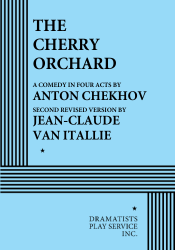
THE STORY: The action takes place at the country estate of Madame Ranevskaya, an estate famed for its beautiful cherry orchard—and soon to be sold at auction unless the delinquent taxes are paid. As the play begins Madame Ranevskaya has returned from Paris, where she has frittered away the last of her fortune on a cynical young lover, and it is soon apparent that neither she, nor her family and friends, can come to grips with the crushing reality which they must face, or truly fathom the loss which threatens them. Instead they continue to go on as if nothing had changed, and only the rich merchant Lopakhin, the nouveau riche son of a peasant, seems to realize the gravity of the situation. Ironically it is he who bids successfully for the estate and who sets his men to felling the trees as, in the bittersweet finale, Madame Ranevskaya departs again for Paris and the fragile promise of a new and perhaps better life.
A brilliant new rendition of a modern classic.
“To stage a classic is an easy thing but to restore that classic to the hands, mind and blood of its creator is in itself an act of creativity...I don’t think I have ever seen anything quite like this production on a stage before—I left the theatre exhilarated.” —The New York Times.
“…a new, faithful, very playable and gorgeous translation by Jean-Claude van Itallie.” —New York Post.
“Jean-Claude van Itallie’s adaptation is splendid, colloquial without being cute, simple, moving, funny.” —Village Voice.
Joins other van Itallie adaptations of Chekhov:
The Sea Gull,
Three Sisters, and
Uncle Vanya.