Home

Browse Plays
Now Published
New Acquisitions
Musicals
Pulitzer Winners
Tony Winners
Manuscripts
ePlays
Special Collections
52nd Street Project
Children's Plays
Catalogues

Nonprofessional
Professional
Competitions
Foreign Agents

Page to Stage
Center Stage
atPlay Newsletter

Sign In
View Cart
Pay Invoice Fees
Edit Account
New Account
Sign Out

Author Bios
Incidental Music
Other Recordings
Sound Effects
Images and Video

FAQs
Ordering Plays
Applying for Rights
Shipping Info
Reprint Rights

Contact Info

Author Sites
Industry Links


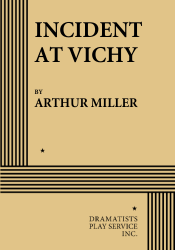
Incident at Vichy

Arthur Miller

Drama
Full Length

21 men: 21 total
Interior

An intense, meaningful play which deals with the Nazis' inhuman treatment of the Jews—and the burden of guilt which all men must share. "Arthur Miller has written a moving play, a searching play, one of the most important plays of our time…INCIDENT AT VICHY returns the theater to greatness." —NY Times. "…continuously absorbing…" —NY Post. "A seething, searing and profoundly stirring drama." —Associated Press.

Book/Item: INCIDENT AT VICHY
Book Type: DPS
Price: $8.00
ISBN/Code: 978-0-8222-0564-7

FEE: $100 per performance.

THE STORY: In the detention room of a Vichy police station in 1942, eight men have been picked up for questioning. As they wait to be called, they wonder why they were chosen. At first, their hopeful guess is that only their identity papers will be checked. But it soon develops that all of them are either Jews or are suspected to be. Two of the prisoners and one German policemam are the focal point of the play. The German is a wounded combat officer forced into the police assignment and detests it. More important though, are the other two. One is a former French officer, who has thoughts of overpowering the guard and trying to escape. The second is an Austrian nobleman, who had left Vienna in disgust after the Nazi occupation. A gentle lover of the arts, he despises the Nazis mainly because they are crude, vulgar and tasteless. In the end, the dramatic confrontation is between these two. The Frenchman is suspicious of the Austrian because he is convinced that all non-Jews have within them a strain of anti-Semitism. The Austrian must protest that he is not merely a superficial and theoretical idealist. In the end, he proves this by sacrificing his own life so that the Frenchman may go free, an act that confounds the suspicions of the one he saved, and redeems, at least in part, the concern and honor of decent men everywhere.


Quantity to Order: